
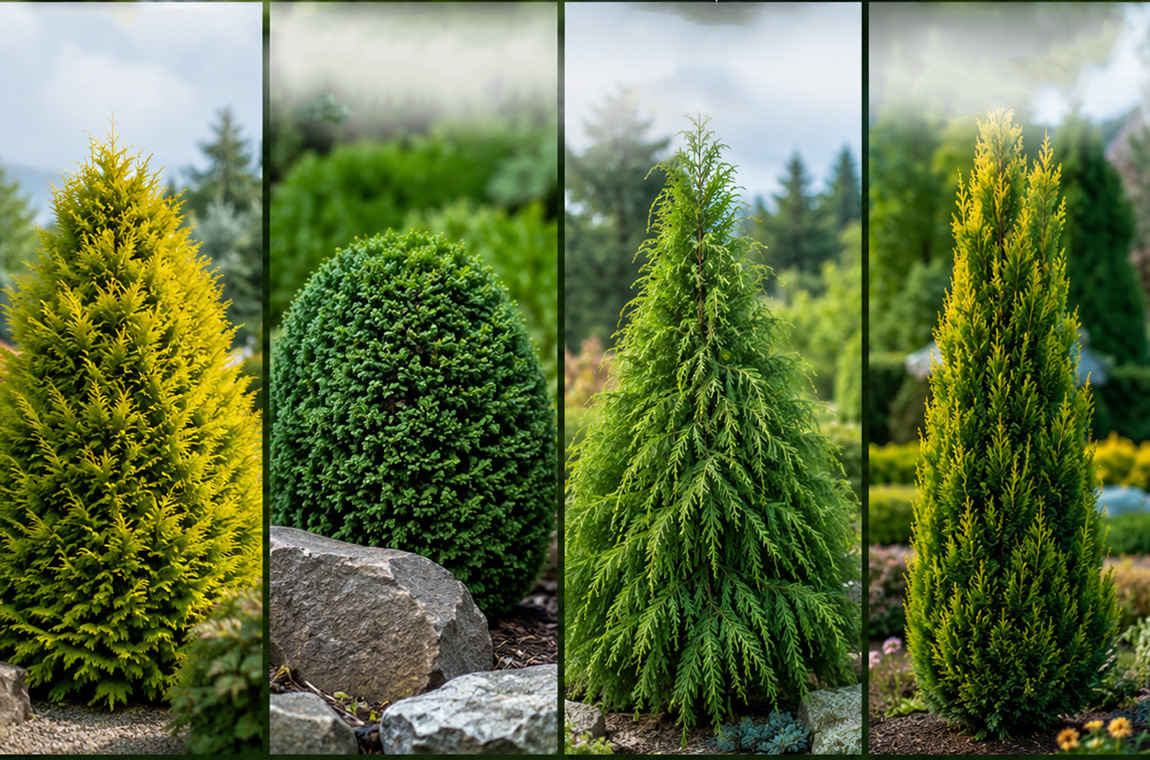
Hinoki Cypress Varieties for the Northeast
Hinoki cypress (Chamaecyparis obtusa) is one of the most “designer-friendly” evergreens we use in Northeast landscapes. It’s evergreen, architectural, and refined, with sculptural branching, rich fan-like foliage, and beautiful texture that reads as intentional all year long. It also comes in an incredible range of sizes, from true dwarfs for foundation beds and rock gardens to statement trees that anchor a front entry.
In this guide, we’ll walk through useful and popular Hinoki varieties (cultivars), including Hinoki ‘Crippsii’, while clarifying an important difference: there is also a non-Hinoki “cypress ‘Crippsii’” (Monterey cypress, Cupressus macrocarpa ‘Crippsii’) that is a different plant entirely.
Why Hinoki Cypress Works So Well in the Northeast
What we like about Hinoki (from a design-build perspective):
Four-season structure: You get year-round form without relying on flowers.
Texture that elevates a planting bed: Fine, layered “fan” foliage pairs beautifully with hydrangeas, boxwoods, ornamental grasses, and boulders.
Huge range of mature sizes: The cultivar choice matters more than almost anything else.
Often deer-resistant (not deer-proof): In many Long Island and Northeast settings, Hinoki is browsed less than arborvitae.
Hinoki typically does best with even moisture, good drainage, and protection from harsh drying winds, especially for golden varieties that can scorch in winter sun/wind.
Meaning of “Crippsii”
1) Golden Hinoki ‘Crippsii’
Botanical name: Chamaecyparis obtusa ‘Crippsii’
Common name: Golden Hinoki Cypress / Golden Hinoke
This is a Hinoki cultivar with golden foliage and an upright, pyramidal form.
2) Monterey Cypress ‘Crippsii’ (not Hinoki)
Botanical name: Cupressus macrocarpa ‘Crippsii’
This is a different species—a fast-growing Monterey cypress cultivar used for screening/hedging in many climates.
If you’re shopping nurseries, the label matters. Chamaecyparis obtusa ‘Crippsii’ is Hinoki, while Cupressus macrocarpa ‘Crippsii’ is Monterey cypress.
Hinoki Cypress Varieties (Cultivars) We Use & Recommend Most Often
1) Chamaecyparis obtusa ‘Nana Gracilis’
Often called Dwarf Hinoki Cypress, it has dense, shell-like fans stacked in layers and a sculptural appearance. It works well as a classic foundation evergreen, front foundation focal point, entryway plant, or accent in mixed evergreen beds. It is slow growing but can become substantial over many years.
2) Chamaecyparis obtusa ‘Nana’
A tighter, compact dwarf form with a small, rounded habit and rich green texture. It works where boxwood might struggle while providing a different texture.
3) Chamaecyparis obtusa ‘Nana Aurea’ (Golden Dwarf Hinoki)
For homeowners who want a gold accent without going tall, ‘Nana Aurea’ provides golden tips and warm color with strong contrast against dark evergreens and stonework. Gold conifers can bronze in winter, so protection from wind and winter sun can help.
4) Chamaecyparis obtusa ‘Crippsii’ (Golden Hinoki ‘Crippsii’)
This cultivar “glows” in the landscape with upright, pyramidal structure and golden foliage. It works as a front-yard specimen, mixed evergreen screen, or year-round backdrop behind hydrangeas and perennials. Avoid repeated drying and heavy salt exposure.
5) Chamaecyparis obtusa ‘Fernspray Gold’
A popular golden Hinoki with softer, more “sprayed” texture than ‘Crippsii’. Its feathery golden foliage works well for layering in evergreen beds.
6) Chamaecyparis obtusa ‘Butter Ball’
A round, dwarf “mound” that is useful for tidy foundation lines, repeating rhythm, symmetry, and walkways.
7) Chamaecyparis obtusa ‘Chirimen’
A textured, compact Hinoki with an unusual “crinkled” foliage effect. It adds collector-level texture and works as a conversation piece in a front bed or courtyard.
8) Chamaecyparis obtusa ‘Blue Feathers’
A cooler blue-green Hinoki cultivar useful when a planting bed needs contrast rather than more green.
Other Notable Hinoki Cultivars
‘Tempelhof’ – green-yellow tones, often bronzes in winter.
‘Spiralis’ – stiff, upright dwarf character for architectural accents.
‘Tetragona Aurea’ – larger-growing golden selection with strong vertical presence.
‘Tsatsumi Gold’ – contorted branches and yellow-green foliage for specimen texture.
Availability varies by nursery and season in the Northeast.
Monterey Cypress ‘Crippsii’ — When Clients Mention It
Monterey cypress ‘Crippsii’ (Cupressus macrocarpa ‘Crippsii’) is typically described as a fast-growing, upright evergreen used for screening and hedging, with golden-blue/green scale foliage. Larger screening applications may use it, but Northeast winters, wind exposure, and site conditions can be limiting depending on location and microclimate.
For the classic Hinoki look, stick with Chamaecyparis obtusa cultivars such as ‘Crippsii’, ‘Fernspray Gold’, or ‘Nana Gracilis’.
How Louis Contino Landscaping Chooses the “Right” Hinoki
When specifying Hinoki cypress, we match the cultivar to four real-world factors:
1) Mature size and spacing: Consider walkways, driveways, foundations, and visibility from key angles.
2) Light exposure: Green Hinoki generally handles exposure better, while Golden Hinoki often looks best with morning sun and afternoon protection.
3) Soil drainage: Hinoki does not like “wet feet.” Drainage issues can occur in compacted construction zones or low spots.
4) Design role: Hinoki can serve as a specimen anchor, foundation structure, or texture layer in screening.
Simple Care Tips for Northeast Homeowners
Planting basics: Dig wide, keep the root flare visible, and mulch 2–3" thick while keeping mulch away from the stem.
Watering: The first year matters most. Deep water consistently and avoid repeated drought cycles.
Pruning: Light shaping is fine, but avoid aggressive shearing. Hinoki is prized for its natural form.
Winter protection: Avoid salt spray zones near roads and driveways. In very exposed sites, burlap wind protection can help reduce winter burn.
Which Hinoki Is Right For Me?
Want a classic, sculptural evergreen for the foundation? → ‘Nana Gracilis’
Need a small round evergreen to repeat in a bed? → ‘Butter Ball’
Want a gold accent but keep it compact? → ‘Nana Aurea’
Want a gold statement evergreen with upright form? → Hinoki ‘Crippsii’
Want soft, feathery gold texture? → ‘Fernspray Gold’