
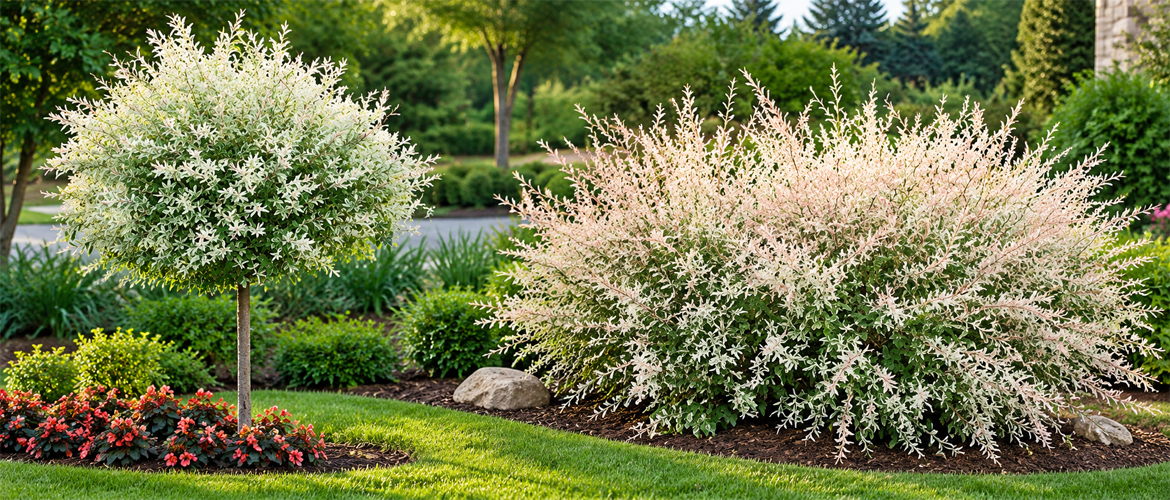
Dappled Willow ‘Hakuro Nishiki’ Varieties
If you want a shrub that looks hand-painted, Dappled Willow offers pink spring growth, creamy white and green summer foliage, and bright coral-red winter stems. The cultivar is Salix integra ‘Hakuro-nishiki’, commonly sold as Dappled Willow, Tricolor Willow, or Flamingo Willow.
At Louis Contino Landscaping (Oyster Bay / Long Island), we use dappled willows to add colour, soft texture, and architectural interest to landscapes. Depending on how they are grown and pruned, they can create a polished lollipop-shaped tree or a relaxed, multi-stem shrub.
Understanding Dappled Willow Forms
Most homeowners choose between three options:
Shrub form: A traditional, multi-stem plant with a rounded shape.
Standard/tree form: A plant grafted onto a straight trunk, creating a rounded canopy.
Flamingo Willow: A name often used for plants with a similar appearance, particularly standard forms.
The main differences are size, structure, and maintenance rather than appearance.
The Classic: Shrub Form
Appearance and Size
The traditional shrub produces pink new growth in spring, followed by green leaves dappled with creamy white. The pink tones become more subtle as summer progresses. It typically grows around 4–6 feet tall with a spread of 5–7 feet, although it can grow larger without pruning.
Best Landscape Uses
Statement plantings near entrances
Soft screening and foundation beds
Rain garden edges and consistently moist areas
Contrasting against darker evergreen shrubs
Regular pruning helps maintain a dense shape and vibrant foliage.
The Showpiece: Standard or Tree Form
A standard is grafted onto a straight trunk, creating a small tree with a rounded canopy. It provides a clean, architectural appearance and works well in tight spaces.
Popular placements include front walkways, entrance steps, pool patios, and containers. Paired standards can create a symmetrical, elegant landscape design.
This form requires regular canopy shaping and immediate removal of shoots growing from the trunk or below the graft. It may also be more vulnerable to cold winds than a shrub.
Is Flamingo Willow Different?
“Flamingo Willow” is often used as a common name for ‘Hakuro-nishiki’, especially for standard forms. When purchasing, check whether the plant is a shrub or standard, the trunk height, pot size, and canopy dimensions.
For stronger pink growth, provide adequate sunlight, consistent moisture, and appropriate pruning.
Sunlight, Water, and Soil
Light: Full sun to partial shade is generally suitable. More sunlight often encourages stronger colour and tighter growth, while excessive shade can result in greener foliage.
Water: Dappled Willow prefers consistently moist soil and tolerates wetter conditions better than many ornamental plants. Summer drought, sandy soil, and heat-reflecting patios can cause stress. Consistent irrigation and mulch help maintain moisture.
Soil: Choose a location with adequate drainage, steady moisture, and protection from excessive reflected heat.
Pruning for Better Colour
The most colourful foliage develops on fresh growth, making pruning essential for maintaining the plant's appearance.
Shrub Form
Late winter or early spring: Reduce the plant by approximately one-third, shaping it into a rounded form.
Early summer: Lightly trim if needed to encourage another flush of growth.
Every few years: Consider harder pruning to refresh the plant and encourage vigorous new shoots.
Standard/Tree Form
Prune in late winter or early spring to maintain a rounded, dense canopy.
Remove shoots growing on the trunk or below the graft throughout the growing season.
Without pruning, the canopy can become uneven and overgrown.
Common Problems and Solutions
Leaf scorch: Brown leaf edges often indicate drought stress or excessive reflected heat. Maintain consistent watering and apply mulch.
Fading foliage: Colour naturally becomes greener during summer. Adequate sunlight and pruning encourage fresh, colourful growth.
Overgrowth: Dappled Willow grows quickly. Allow sufficient space near paths, steps, and driveways, and prune regularly.
Pests: Good airflow, proper watering, and timely pruning help maintain plant health.
Landscaping Ideas and Buying Tips
Dappled Willow looks striking against boxwood, inkberry holly, yew, and suitable hemlocks. Its soft foliage also complements stone patios, retaining walls, front steps, and boulder accents. Standard forms create elegant symmetry beside walkways, while moist garden edges provide suitable planting locations.
When selecting a plant, check for healthy stems, balanced branching, minimal dieback, and a healthy root system. For matching standard trees, compare trunk height, canopy diameter, and overall symmetry.
Quick Care Summary
Sun: Full sun to partial shade
Water: Consistent moisture
Shrub size: Approximately 4–6 feet tall and 5–7 feet wide
Pruning: Late winter or early spring, with optional summer trimming
Best feature: Colourful new growth and attractive winter stems
Want Help Choosing the Right Form?
Tell us where you plan to place your Dappled Willow—near an entrance, in a side yard, beside a pool, or along a fence. At Louis Contino Landscaping, we can help you choose between a full shrub mass for a softer appearance and a standard tree for a clean, architectural accent.
Either form can add distinctive colour and designed interest to your landscape.